
If you've requested even two or three quotes for a commercial solar system for your factory or facility, you've probably noticed something frustrating: the numbers don't agree with each other, and nobody's quote actually explains what you're paying for. One vendor quotes you ₹32/watt. Another quotes ₹55/watt for what looks like the same system. Are you being overcharged? Underquoted? Or just looking at two completely different things dressed up to look the same?
Here's the short answer: you're probably comparing panel price with installed system cost — two very different numbers that get mixed up constantly in this industry. And in 2026, there's a second wrinkle: commercial solar cost in India has risen sharply, so a quote that felt reasonable a year ago no longer reflects reality.
This article breaks down exactly what a commercial solar system costs in India today, size by size, what's actually included in that cost, and why your 2025 benchmark is outdated.
Panel Price vs. Installed Commercial Solar Cost: The Confusion That Costs You Money
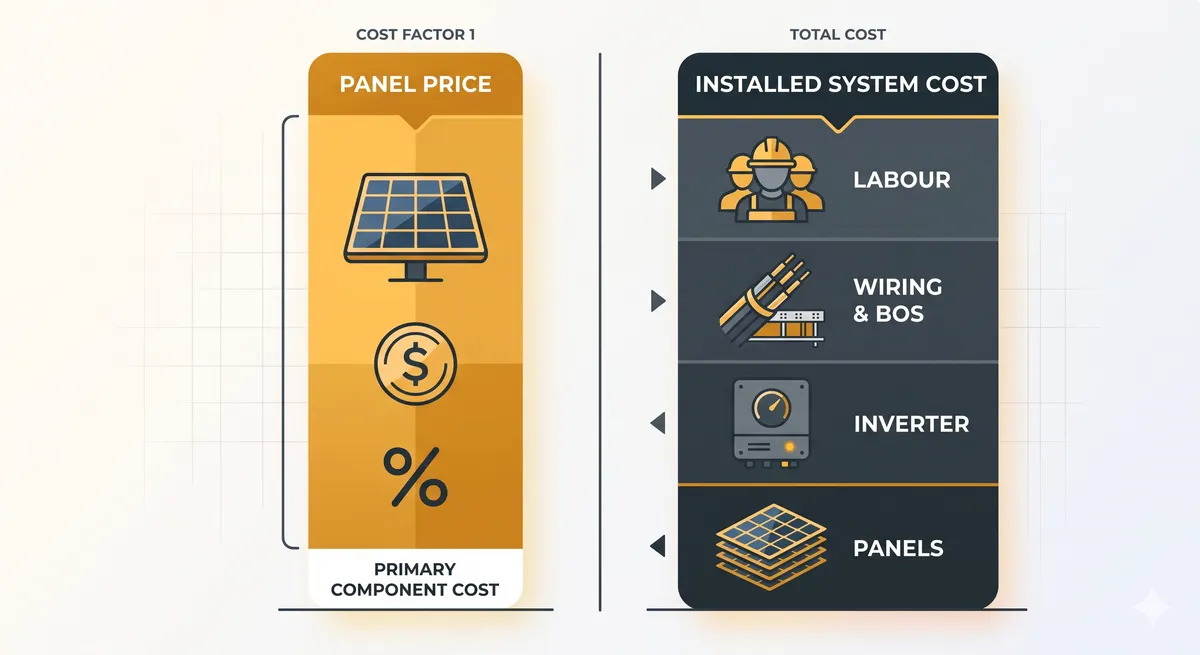 Most confusion around commercial solar cost in India starts with a simple mix-up: the price of the solar panel itself is not the price of your solar system.
- Panel-only price: roughly ₹22–38 per watt, depending on technology. Standard polycrystalline panels sit at the lower end; premium bifacial mono-PERC or TOPCon panels sit at the higher end.
- Fully installed system cost: roughly ₹45–70 per watt, all-inclusive.
The gap between these two numbers is the inverter, mounting structure, cabling, earthing, protection equipment, structural reinforcement (especially relevant for industrial roofs), labour, and grid commissioning. When a vendor quotes you a number that sounds too good, ask directly: is this the panel price or the installed cost? That single question eliminates most apples-to-oranges comparisons before you've spent a rupee.
Commercial Solar Cost in India 2026: Real Numbers by System Size
There's no single "commercial solar cost" — the right number depends heavily on system size, location, and the complexity of your roof or site. Here's a realistic, size-segmented view for 2026.
100 kW Commercial Solar System
A 100 kW system is the typical entry point for mid-sized factories, warehouses, or office buildings with meaningful daytime power consumption.
- Total installed cost: approximately ₹45 lakh to ₹60 lakh
- Roof area required: roughly 500–700 square metres of shadow-free space
- Best suited for: mid-sized manufacturing units, educational institutions, and commercial complexes
500 kW Commercial Solar System
This is where economies of scale start working noticeably in your favour — the per-watt cost drops as the system gets larger.
- Total installed cost: approximately ₹2 crore to ₹2.75 crore
- Roof or ground area required: roughly 0.8–1 acre for ground-mounted configurations
- Best suited for: larger manufacturing facilities, IT campuses, hospitals, and industrial parks
1 MW Commercial Solar System
At this scale, you're typically looking at large factories or multi-building industrial campuses, and project financing options like third-party PPAs become viable.
- Total installed cost: approximately ₹3.5 crore to ₹4.5 crore per MW
- Roof or ground area required: correspondingly larger, often requiring a dedicated ground-mount or carport configuration
As a rule of thumb: the per-watt commercial solar cost decreases as system size increases, because fixed costs (design, commissioning, project management) get spread across more capacity.
Why Commercial Solar Cost Has Risen ~25% in 2026
If you're benchmarking against a quote from 2024 or 2025, here's the uncomfortable truth: commercial and industrial solar project costs have risen by roughly 25% year-over-year in 2026. There are two forces driving this, and both matter for your planning.
1. ALMM enforcement. India's Approved List of Models and Manufacturers (ALMM) framework increasingly requires solar modules — and now, the solar cells inside those modules — to come from domestically approved manufacturers for certain project types. This is reshaping supply and pricing across the industry. (We cover exactly what this means for your project, and the hard June 2026 deadline involved, in detail in our companion article on the new module rules.)
2. Shifting global supply dynamics. Changes in China's export policies, combined with global module demand, have tightened the supply-cost equation for Indian buyers, particularly for premium high-efficiency panels.
The practical implication: if you got a commercial solar quote more than six months ago, get a fresh one. The number you were planning around may no longer be accurate, and the gap could be the difference between a project that pencils out and one that doesn't.
What's Actually Inside Your Commercial Solar Cost — And What a Vendor's Quote Should Break Down
A trustworthy quote for a commercial solar system should itemize, not bundle, the following:
- Panel brand, technology, and ALMM listing status — confirm the specific model is currently on the approved list, not just the manufacturer in general
- Inverter brand, capacity, and warranty terms — string inverters and inverters with optimizers carry meaningfully different costs and performance profiles
- Structural and mounting costs for your specific roof type — industrial roofs (especially metal sheet roofing common in factories) often require additional structural assessment and reinforcement that flat-rate quotes sometimes skip
- Wiring, earthing, and protection equipment — these are not optional add-ons; they're safety-critical and code-required
- Commissioning, grid approval, and net metering paperwork — someone has to handle DISCOM coordination, and that work has real cost and timeline implications
- Post-installation AMC/O&M terms — a system without a clear maintenance plan loses 10–20% of its output within a few years due to soiling and component degradation
If a quote for your commercial solar system doesn't break these out individually, that's a red flag — not because the vendor is necessarily dishonest, but because you can't actually compare it to a competing quote, and you can't know what you've agreed to until something goes wrong.
Getting a Quote You Can Actually Compare
 The goal isn't to find the cheapest number on a page — it's to find the lowest total cost of ownership for a system that will run reliably for 25 years. That means asking every vendor for the same itemized breakdown, confirming ALMM compliance explicitly (this matters more than ever in 2026 — more on that below), and understanding the real payback math before you sign anything (which we break down fully in our ROI guide).
If you're currently comparing quotes for a commercial or industrial solar system, SOLEV can give you a transparent, fully itemized proposal — no bundled numbers, no guessing what's included.
Get a transparent solar quote for your facility from SOLEV →
Frequently Asked Questions
1. What is the average commercial solar cost in India in 2026?
Commercial solar cost in India in 2026 ranges from roughly ₹45 to ₹70 per watt for a fully installed system, depending on size, location, and component quality. A 100 kW system typically costs ₹45–60 lakh, a 500 kW system ₹2–2.75 crore, and a 1 MW system ₹3.5–4.5 crore.
2. Why did commercial solar cost increase in 2026?
Commercial solar cost rose by approximately 25% year-over-year due to ALMM enforcement (which restricts module and cell sourcing for certain project types) and shifts in global solar supply chains, including changes in China's export policies.
3. Is commercial solar cost the same as the panel price I see online?
No. Panel-only prices (₹22–38/watt) cover just the module. The fully installed commercial solar cost (₹45–70/watt) includes the inverter, mounting structure, wiring, earthing, protection equipment, labour, and grid commissioning.
4. Does commercial solar cost decrease with larger system sizes?
Yes. Per-watt commercial solar cost generally decreases as system size increases, since fixed costs like design and commissioning are spread across more installed capacity. This is why 1 MW systems typically have a lower per-watt cost than 100 kW systems.
5. How do I know if a commercial solar quote is fair?
A fair quote itemizes panel brand and ALMM status, inverter specifications, structural/mounting costs, wiring and safety equipment, commissioning and net metering handling, and AMC/O&M terms separately. If a quote bundles all of this into a single number, it's difficult to compare against competing offers.
6. Are there subsidies that reduce commercial solar cost in India?
No broad central capital subsidy currently applies to private commercial and industrial solar projects (PM Surya Ghar is a residential-only scheme). Commercial buyers instead benefit from accelerated depreciation, lower operating electricity costs, and in some cases state-level incentives — covered in detail in our ROI and payback guide.