
Every solar vendor pitching your factory will tell you the same thing: "3 to 5 year payback." It's become such a standard line that it's stopped meaning anything. The real question isn't whether that range is possible — it's whether it applies to your facility, under your tariff, with your financing structure. Without seeing the underlying math, "3 to 5 years" is just a sales line, not a financial commitment.
This article walks through the actual industrial solar ROI math: what drives payback period, what tax benefits actually apply to commercial buyers (and which ones don't), and how to decide between owning your system outright versus a zero-upfront-cost alternative.
The Subsidy Myth: What Commercial and Industrial Solar Buyers Actually Get
Let's clear up the most common misunderstanding first, because it derails a lot of industrial solar ROI conversations before they even start.
PM Surya Ghar Muft Bijli Yojana — India's flagship solar subsidy scheme — is a residential program. It does not apply to private commercial or industrial solar buyers. If a vendor implies you'll receive a central capital subsidy similar to what homeowners get, that's not accurate for your situation.
There's also no broad central capital subsidy for private commercial and industrial (C&I) solar projects more generally in 2026. Government-backed schemes like the CPSU Scheme Phase II exist, but they're built for public sector undertakings and government entities — not private factories.
So where does the financial case for industrial solar ROI actually come from? Two places:
- Lower electricity costs. Solar-generated electricity for commercial and industrial users now costs roughly ₹3.0–3.5 per kWh (levelized cost of electricity, or LCOE) — a sharp drop from ₹4.5–5.0 per kWh just a few years ago. For most C&I consumers, that's meaningfully below grid tariffs.
- Accelerated depreciation. As a business asset, your solar installation qualifies for depreciation benefits under Indian tax provisions, which materially improves the after-tax economics. (We're intentionally not quoting a specific depreciation rate here — tax provisions can change, and you should confirm the current applicable rate with your CA before building it into your model.)
Worked Example: Industrial Solar ROI for a 1 MW Captive Plant
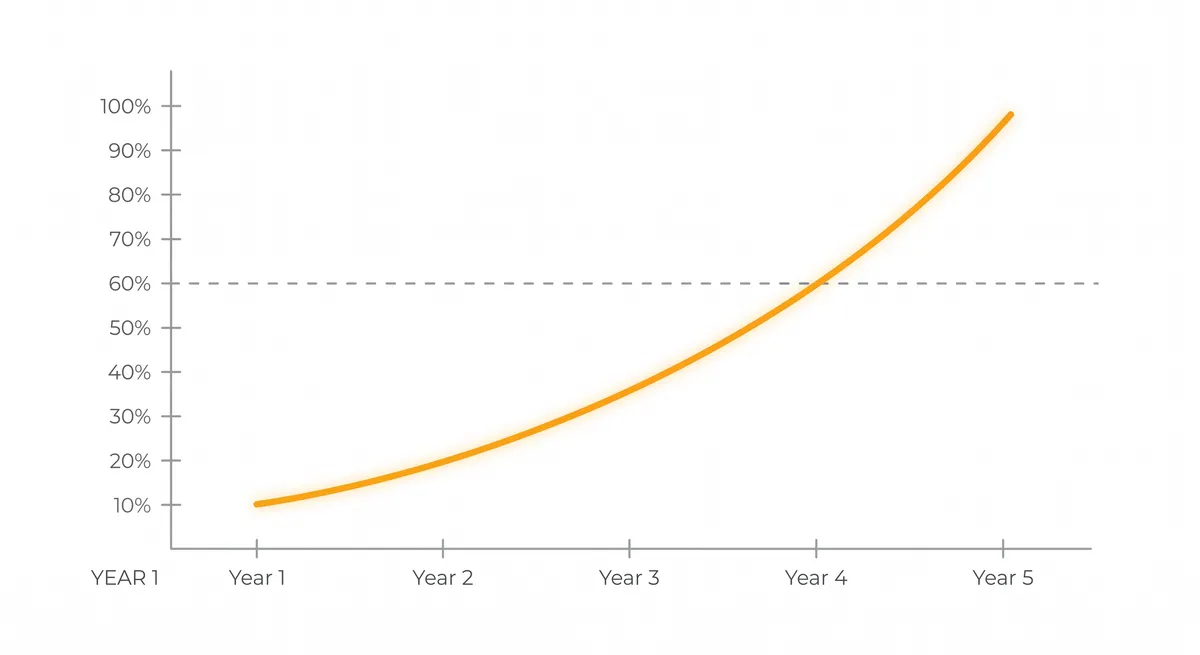 Numbers make this concrete. Here's an illustrative — not promotional — walkthrough of how industrial solar ROI is typically modeled for a 1 MW captive rooftop or ground-mounted plant.
- Annual generation: A 1 MW plant operating at a realistic capacity utilization factor (CUF) of around 19% generates approximately 16–17 lakh units (kWh) per year.
- Energy value created: If that generation offsets grid power at a representative industrial tariff of around ₹7/kWh, the gross energy value is approximately ₹1.1–1.2 crore per year.
- Net operating benefit: After accounting for operations and maintenance (O&M) costs, the net annual benefit typically lands around ₹1.0–1.1 crore.
- Payback window: Against a total installed cost of roughly ₹3.5–4.5 crore for a 1 MW system, this generally produces a payback period in the range of 3 to 4 years — consistent with industry benchmarks, but only once you've seen exactly how that number was derived.
This is illustrative math, not a guarantee — your actual industrial solar ROI will depend on your specific tariff, your state's net metering or open access rules, your roof or land configuration, and your financing structure. But this is the kind of calculation your vendor should be willing to walk through with you, line by line, rather than just stating a headline payback figure.
CAPEX vs. RESCO/PPA: Which Funding Model Actually Fits Your Business
There isn't just one way to finance a commercial solar project, and the model you choose changes your industrial solar ROI picture significantly.
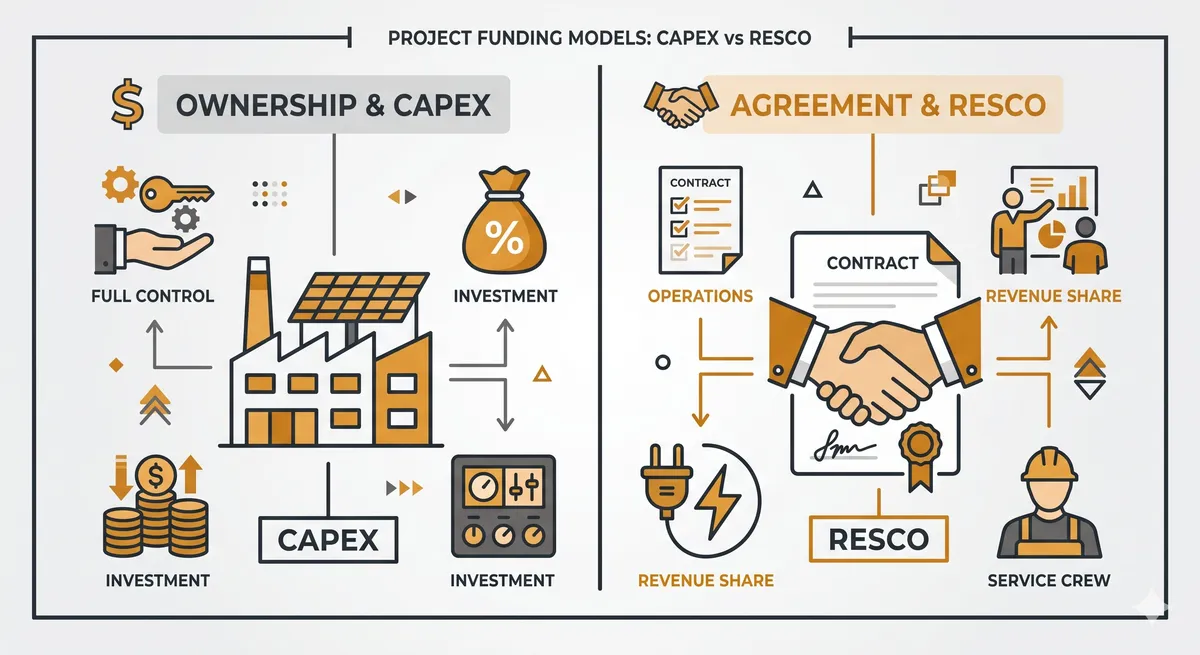
CAPEX Model (You Own the Asset)
- You pay the full installed cost upfront (or via a loan)
- You own the system and the electricity it generates
- You're eligible for the full accelerated depreciation tax benefit
- Higher upfront cash requirement, but the strongest long-term financial upside
RESCO / PPA Model (Zero Upfront Cost)
- A third-party developer installs and owns the system on your roof or land
- You pay a discounted, pre-agreed rate per unit of electricity consumed — typically lower than your grid tariff
- No upfront capital outlay, no depreciation benefit (since you don't own the asset)
- Lower risk, lower complexity, but a smaller share of the long-term financial benefit stays with you
A simple way to decide: if your business has available capital and meaningful tax appetite, CAPEX generally delivers stronger long-term industrial solar ROI. If you'd rather avoid tying up capital or taking on asset ownership risk, RESCO/PPA gets you immediate savings with zero upfront investment — a reasonable trade-off for many growing businesses.
What Vendor ROI Pitches Usually Leave Out
A polished sales pitch and an honest industrial solar ROI model often look very different. Here's what tends to get glossed over:
- Module degradation over time. Solar panels lose a small percentage of output capacity every year over their 25-year lifespan. A model that assumes flat generation for 25 years is overstating your long-term returns.
- Realistic O&M costs. Skipping or underbudgeting maintenance can mean losing 10–20% of generation to soiling and component wear within just a few years — directly eating into the savings your payback calculation assumes.
- Tariff escalation assumptions. Most vendor pitches calculate savings using today's electricity tariff. If your state's grid tariffs rise over the next several years (historically a near-certainty), your real savings — and real industrial solar ROI — could be even better than the original pitch suggested. But if a vendor's model doesn't disclose its tariff assumption at all, you can't tell whether you're looking at a conservative number or an inflated one.
Build Your Own Number — Don't Borrow Theirs
The honest version of industrial solar ROI isn't a single sales-deck number — it's a model built around your actual tariff, your actual roof or land, your actual financing preference, and a realistic maintenance plan. Any vendor unwilling to walk you through that full model, line by line, is asking you to take their payback claim on faith.
SOLEV builds a customized ROI model for every facility we work with — not a generic payback range, but your actual numbers.
Request a customized ROI model for your facility from SOLEV →
Frequently Asked Questions
1. What is a typical industrial solar ROI payback period in India?
Most commercial and industrial solar systems in India achieve payback within 3 to 5 years, depending on system size, your local electricity tariff, financing model, and maintenance plan. The exact figure should come from a model built around your specific facility, not a generic industry range.
2. Do commercial and industrial solar buyers get a government subsidy in India?
No. PM Surya Ghar Muft Bijli Yojana, India's main solar subsidy scheme, applies only to residential consumers. Private commercial and industrial buyers don't receive a comparable central capital subsidy, though they can access accelerated depreciation benefits and, in some states, additional incentives.
3. What's the difference between CAPEX and RESCO models for industrial solar ROI?
Under CAPEX, you pay the full cost upfront, own the system, and capture the full depreciation tax benefit along with the strongest long-term ROI. Under RESCO/PPA, a third party owns and operates the system on your premises, you pay a discounted per-unit rate with zero upfront cost, but you don't receive ownership benefits like depreciation.
4. How does accelerated depreciation affect industrial solar ROI?
As a business asset, a solar installation qualifies for depreciation benefits under Indian tax provisions, which improves after-tax returns for buyers using the CAPEX ownership model. The exact applicable rate can change, so it's worth confirming the current provision with your tax advisor before finalizing your financial model.
5. What do solar vendors typically leave out of their ROI pitches?
Common omissions include long-term panel degradation, realistic ongoing O&M/maintenance costs, and the electricity tariff escalation assumption used in their payback calculation. Ask your vendor to disclose all three explicitly before relying on their payback number.
6. Is industrial solar ROI different for a 100 kW system versus a 1 MW system?
Yes. Larger systems generally benefit from better per-watt installation costs and stronger economies of scale, which can improve payback timelines. However, site-specific factors like roof condition, shading, and local tariff structure also significantly affect the final ROI for any given system size.