
Open SOLEV's free solar quotation generator, enter your monthly electricity bill, pick a roof type and a panel brand, and the screen returns a system size, a price, the PM Surya Ghar subsidy figure, an EMI and a 25-year savings estimate. About two minutes. No sign-up, no phone number wall.
Most first-time buyers in Ahmedabad, Surat or Rajkot ring three dealers and collect three lump sums with no breakdown.
Walk into that call already holding a number.
What SOLEV's free solar quotation generator actually does
It is a web page, nothing to install. Four short sets of questions turn your monthly bill into a system size in kW, a price built from panel brand and wattage, the subsidy you may receive, an EMI if you want finance, and what you save over 25 years.
Every figure updates live. Change the panel wattage from 540 W to 545 W, or drop one panel, and price, EMI and savings all move on the same screen. You see what a decision costs before you make it.
Three kinds of buyer are covered: Residential, Commercial (shops, offices, showrooms) and Industrial (factories and sheds).
Our complete solar panel for home cost and subsidy guide goes deeper than a calculator can.
What you see is an estimate our team confirms after a site check, not a signed contract price.
Shading, meter position and cable runs change things. Still, a dealer who refuses to show you any number before a site visit is managing your expectations, not your roof.
The four steps, and what each one asks you
Step 1 — Your Details. Pick home, business or industry, and enter your location. There is an optional field for an installer's (EPC) details if you are using the tool for a client.
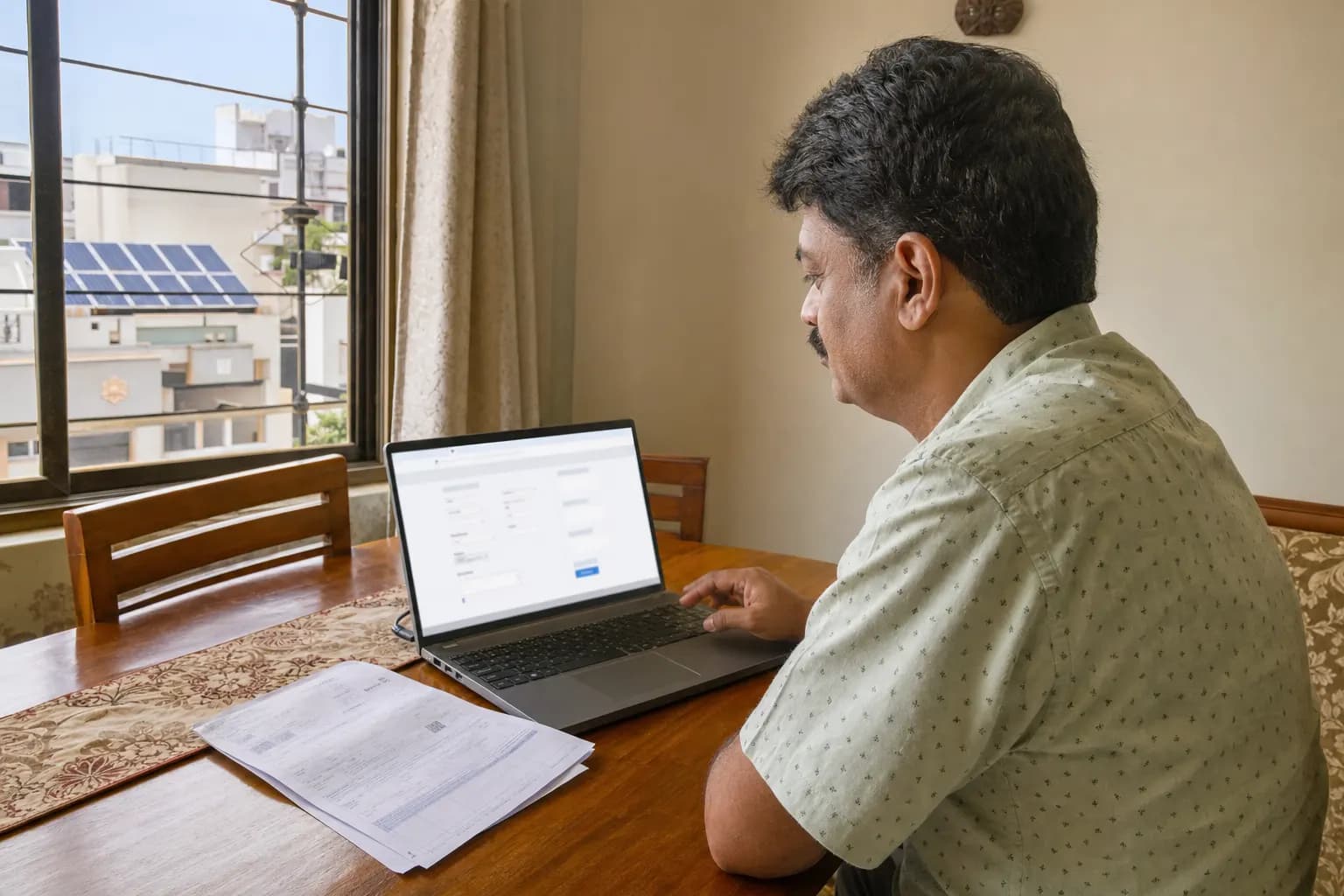
Step 2 — Electricity Bill. Enter your monthly bill in rupees or your consumption in units. The system size appears at once — for a Rs 3,000 bill, about 3 kW. For many people that is the only number they came for.
Step 3 — Roof and Panels. Choose your roof type (Flat/RCC or slanted/shed), the plant type (on-grid, hybrid or off-grid), then panel brand and wattage. The tool suggests a panel count and system size. Override either one — add a panel, drop a panel, watch the numbers respond.
Step 4 — Payment and Savings. Say whether you would pay upfront or take a loan. Price, subsidy, EMI and savings then sit on one screen instead of arriving in three WhatsApp messages a week apart.
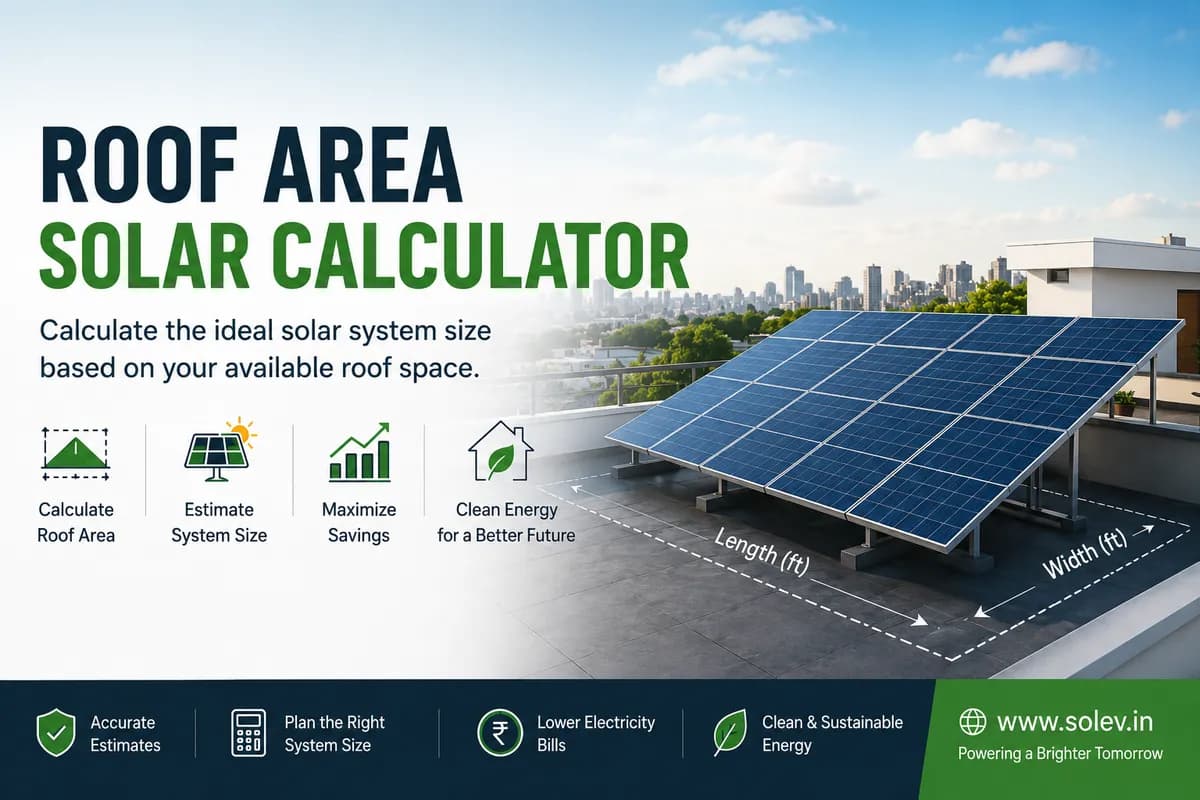
You do not need to measure your roof first. Pick the roof type, let the tool suggest panels, and refine later — or calculate the roof space needed for your solar system yourself.
No login. No callback trap.
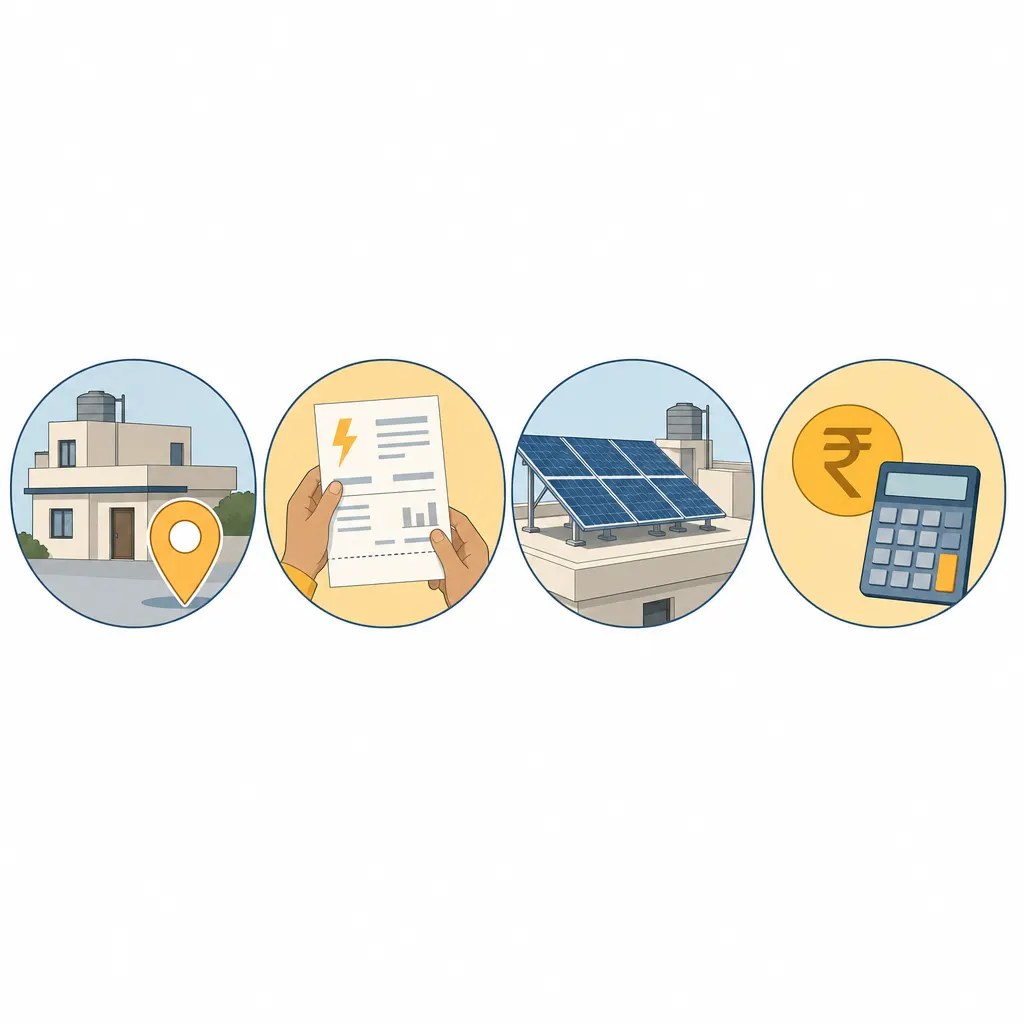 Four steps, each one short.
Where the price comes from, and why that matters
The price comes from SOLEV's current price lists for the exact panel brand, the exact wattage and the panel count you chose. It is not a per-kW average scraped off a search result.
Brand and wattage matter. A 540 W panel from one manufacturer does not carry the price of a 545 W panel from another, and six panels of one brand will not cost what six of another do. When a quote arrives as "Rs X per kW, all inclusive", you cannot tell which panel is going on your roof.
The honest caveat: panel prices move with supply and with GST changes. The screen shows today's figure, not a rate locked for six months.
Try it with your own bill — get your free solar quotation and change the brand twice to see how much the choice matters.
Is the PM Surya Ghar subsidy taken off the price or paid to you later?
Paid to you later. Under the National Portal mechanism, the Central Financial Assistance is transferred directly into the consumer's bank account after installation by an empanelled vendor and verification by the State DISCOM. You pay the full system cost first, then the money comes back.
For eligible homes the amount is up to Rs 78,000 under PM Surya Ghar, which sits inside Phase-II of MNRE's Grid Connected Rooftop Solar Programme — stated window till 31.03.2026, as per the MNRE page last updated 14 February 2025.
The programme's stated objective is 40,000 MW of cumulative rooftop capacity. The scheme's own terms are at https://pmsuryaghar.gov.in.
So, the quotation shows the subsidy as a separate line. It is not deducted from the price, and it is not deducted from your loan amount either. Anyone showing you a "post-subsidy price" as the amount you hand over is describing something the National Portal route does not do.
The confusion has a source. The older State DISCOM portal mechanism did work that way — the consumer paid only the balance and the vendor collected the rest. Buyers who heard about solar three years ago from a neighbour still repeat that version.
In Gujarat, verification means Torrent Power if you are in Ahmedabad or Surat city, and PGVCL, DGVCL, MGVCL or UGVCL depending on your area. That step is what triggers payment. It is not optional paperwork.
Our subsidy service page covers eligibility and documents. MSMEs should separately look at state-level interest subsidy schemes for solar, a different benefit that can stack with finance.
What the loan section shows, including the fees nobody mentions
Choose a partner lender, set your down payment and tenure, and the tool shows the monthly EMI, total interest across the tenure and total repayment. Stretch the tenure and watch the interest climb — that comparison alone is worth the minutes.
Each lender finances up to a set share of the system cost, say 80% or 100%. That share decides your minimum down payment, so the same system can need Rs 0 from you with one lender and a fifth of the cost with another.
Then come the one-time charges, shown apart from the EMI because they are collected when the loan is paid out: a processing fee (a percentage of the loan or a flat amount), GST on that fee, and a stamping fee. Some lenders charge none.
We do not print interest rates here. Lender terms change, and a rate in a blog post ages badly — the tool shows each lender's current terms at the moment you use it.
One more thing to hold in your head: because the subsidy arrives after installation and DISCOM verification, your EMI is calculated on the full amount financed. The subsidy does not shrink it. To run tenure scenarios on their own, use our EMI calculator.
A Gujarat home with a Rs 3,000 monthly bill — worked example
A home in Gujarat enters a monthly bill of Rs 3,000. The tool sizes the requirement at about 3 kW. With 545 W panels selected it suggests 6 panels, which comes to a 3.2 kW system.
That system is estimated to generate about 440 units a month — enough to cover a Rs 3,000 bill at the household's tariff. The PM Surya Ghar subsidy would be paid after installation and DISCOM verification, not netted off the invoice.
The cap is flat. A 3 kW system is the smallest that reaches the full Rs 78,000, and a 10 kW residential system still receives that same maximum, so the rupees-per-kW value of the subsidy is highest at 3 kW and falls from there.
That does not make 3 kW right for you. If your bill is Rs 8,000 a month, sizing down to chase subsidy efficiency only leaves you paying the DISCOM for the rest. Read the example as the tool's reasoning, not a promise about your house.
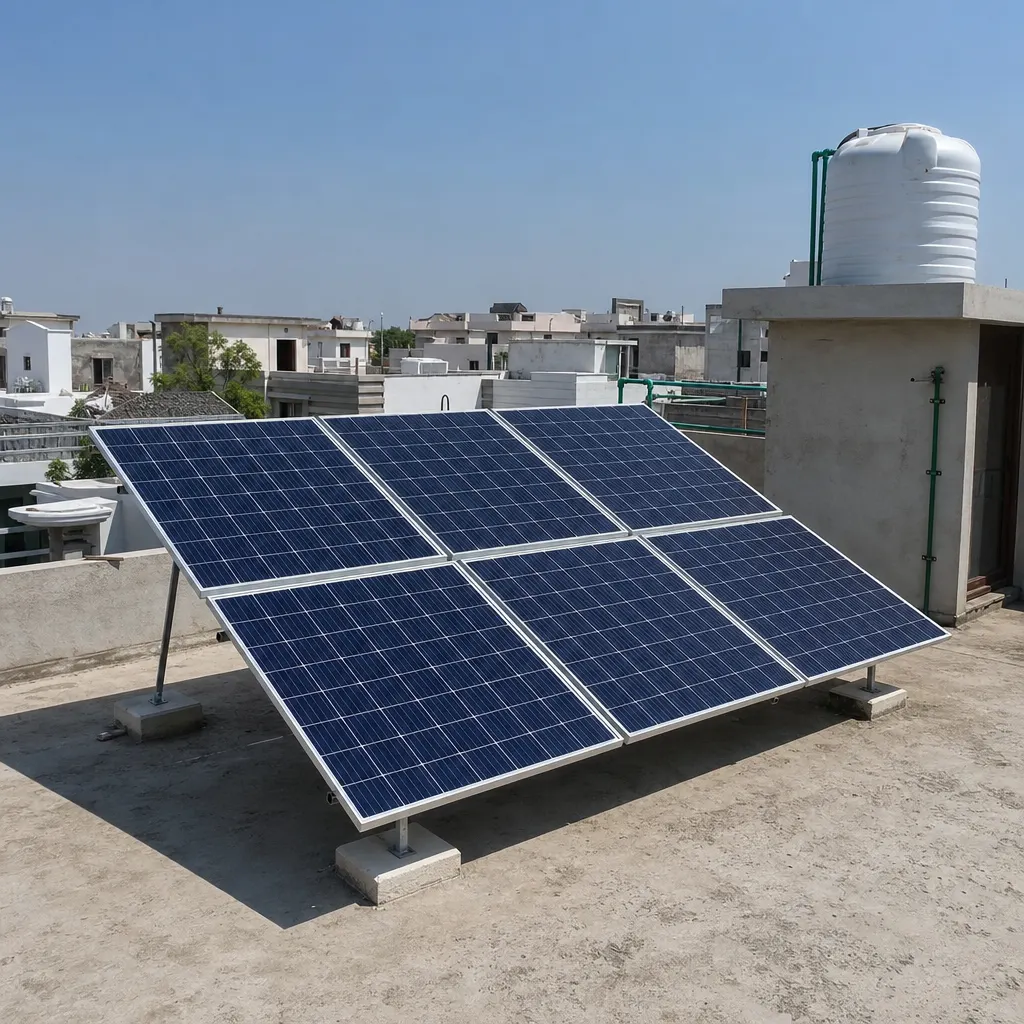 Six 545 W panels make a 3.2 kW system on a typical RCC terrace.
How the savings and payback numbers are worked out
The tool estimates generation from your state's sunshine hours and applies your state's electricity tariff to what those units are worth.
It projects forward on two assumptions: tariffs rising about 5% a year, and about 1% a year set aside for cleaning and minor service.
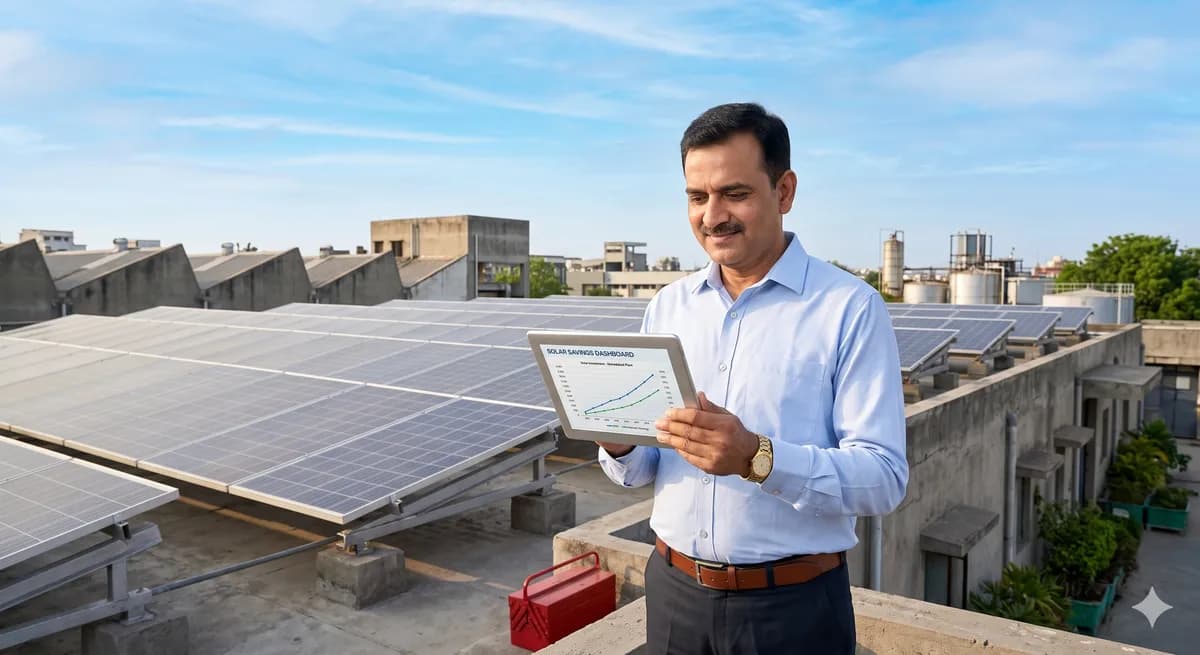
From that it reports your monthly saving, the years to earn back what you paid, and total savings plus profit across 25 years.
These are estimates. A shaded roof, an overhead water tank, a neighbour adding a floor next year or a tariff revision will all move the result, sometimes by a lot. We check shading and roof condition at the site visit before anything is confirmed.
Our solar ROI calculator lets you push the assumptions around yourself.
Does it work for a shop, an office or a factory?
Yes. Select Commercial or Industrial at Step 1 and the tool sizes and prices accordingly.
The maths reads differently from a home. Commercial and industrial tariffs per unit are higher than residential slabs, which usually pulls payback in — but PM Surya Ghar is residential, so a shop or factory should not plan around Rs 78,000 appearing later. Our solar for business page explains what applies instead, and solar for home covers the residential side.
For very large systems the tool gives an indication, and our team prepares the quotation after reviewing load pattern, transformer capacity and shed structure. A 500 kW rooftop is not a scaled-up 5 kW one.
Factory owners can read how solar cuts energy costs for industrial facilities for a sense of where the load actually goes.
What happens after you get your quotation
Your details are saved, and SOLEV contacts you to confirm the site, your subsidy eligibility and your financing options before sharing a final quotation. There is no obligation. Nothing is billed for the estimate.
Those five things change the conversation you have with any installer, including us. Instead of being handed "Rs 2 lakh, everything included" and nodding, you can ask which brand, which wattage, how many panels and what the inverter is. Dealers answer differently when they can tell you already know what the parts cost.
Still deciding whether rooftop solar is worth the trouble? Read why switching to solar makes long-term sense. If your last electricity bill is in hand, skip that and get your free solar quotation now.
Frequently asked questions (FAQs)
Is the free solar quotation really free?
Yes. No payment, no sign-up, no account.
How long does it take?
About two minutes across four steps, if you know your monthly bill or monthly units. Figures update live as you change answers, so exploring options adds a little more.
How accurate is the price?
It comes from SOLEV's current price lists for the panel brand, wattage and panel count you selected, so it is far closer than a per-kW average. It is still an estimate our team confirms after a site check, and panel prices move with supply and GST changes.
Is the PM Surya Ghar subsidy deducted from the price?
No. You pay the full system cost, and the Central Financial Assistance is transferred to your bank account after installation by an empanelled vendor and verification by your State DISCOM — Torrent Power, PGVCL, DGVCL, MGVCL or UGVCL in Gujarat. The quotation shows it as a separate line, up to Rs 78,000 for eligible homes.
Can I pay with a loan, and are there hidden fees?
You can. Pick a partner lender, set a down payment and tenure, and see the EMI, total interest and total repayment. One-time charges — processing fee, GST on that fee, stamping fee — are shown separately from the EMI, and some lenders charge none.
Does it work for commercial and industrial buildings?
Yes, choose Commercial or Industrial at Step 1. For very large systems, our team prepares the quotation after reviewing the requirement.
Do I need to know my roof size first?
No. Pick the roof type — flat/RCC or slanted/shed — plus panels and system size, and the tool handles the rest. Actual fit is confirmed at the site visit.
What is 3kw solar panel price in gujarat with subsidy?
You can easily calculate 3 KW solar system price with our Free Solar Quota generator
Keywords
3 kw solar panel price 4 kw solar panel price 5 kw solar panel price 3 kw solar plant price 4 kw solar plant price 5 kw solar plant price 3 kw solar system price 4 kw solar system price 5 kw solar system price