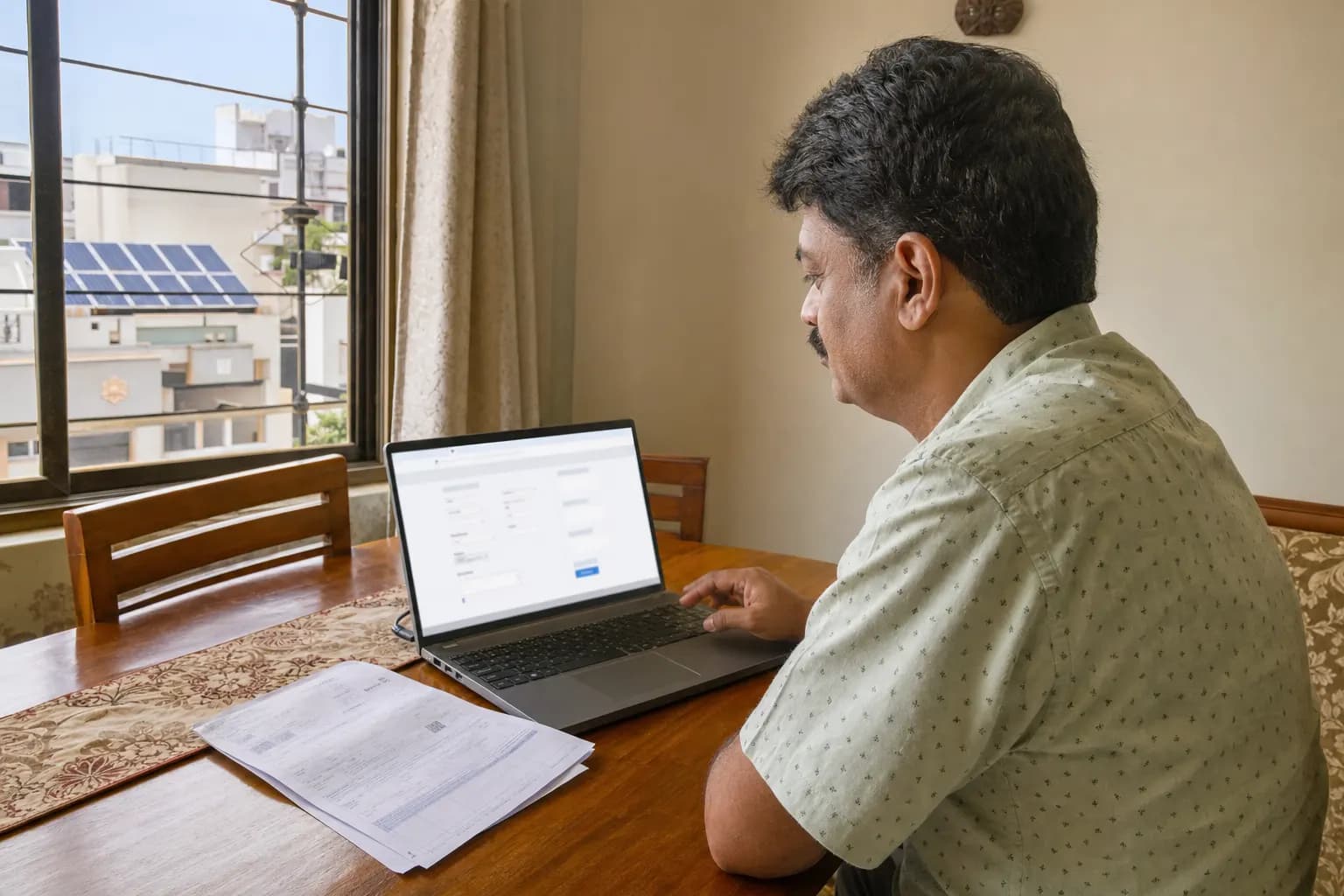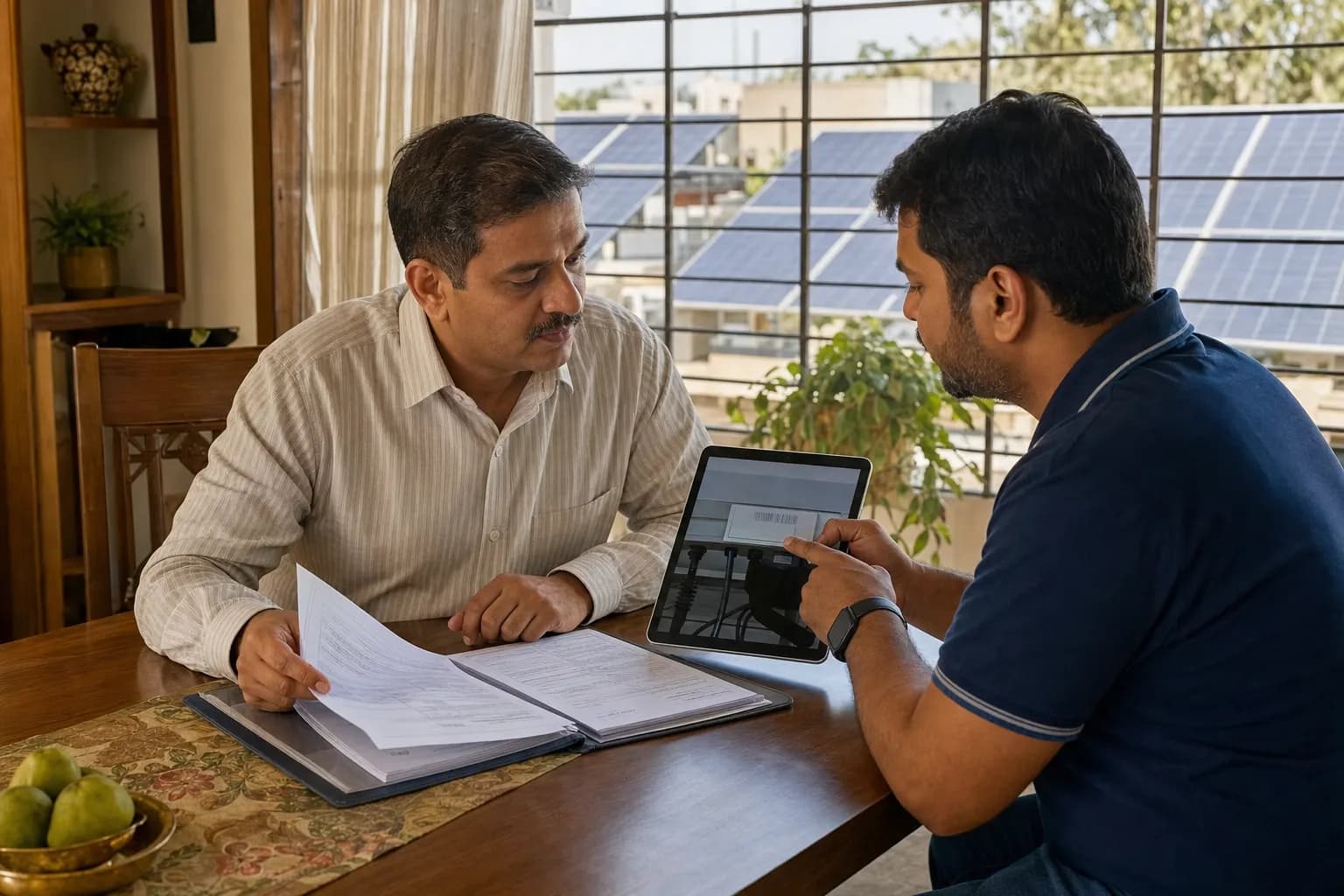

Collect four documents from your installer: warranty certificates with serial numbers, a GST tax invoice, the PPA (only if you did not pay for the system), and DCR proof (only if you took subsidy).
A Rajkot homeowner's inverter claim on a 5 kW rooftop we installed moved in two days in 2024. It moved for one dull reason. The warranty certificate, the module and solar inverter serial numbers and the GST invoice were sitting in one folder he had kept since commissioning day. Panels that look right and an inverter that switches on are not proof of anything.
Figures as of October 2026. Subsidy timelines, net-metering formats and state top-ups vary by state and change often, so confirm the current position on the PM Surya Ghar portal and with your own DISCOM before you sign.
Why the paperwork gets forgotten on commissioning day
The paperwork gets forgotten because commissioning day is noisy and happy, and nobody wants to sit down with a file while the ladders are still being loaded. The net meter runs backwards for the first time, somebody photographs the roof, the team drives off.
But the proof you will need in year five or year eight is created on day one. A manufacturer in 2032 will not accept your memory of what the salesperson said in 2024. They will ask for a certificate, a model number and a serial number, and those exist only if someone wrote them down while the ladders were still up.
Here is the opinion we will stand behind: an installer who gives you a bank account number faster than a document set is telling you how the next ten years will go. Ask for the folder at the quotation stage, not at the end. A good EPC contract already lists the handover documents as a deliverable.
This is a checklist, not a subsidy application guide. If you are still working out what a system should cost and what you are entitled to, read our solar panel for home cost and subsidy guide first, then come back and file the proof of what you paid.
Document 1: Warranty certificates for panels, inverter and the rest
You want separate written warranty proof for three things: the modules, the inverter, and the major balance-of-system items such as the mounting structure, cables and protection devices. Each certificate should carry the make, the model and the serial numbers that match what is actually bolted to your roof. A line in the quotation is not a certificate.
Why it matters is simple. In year five, the manufacturer's service desk asks for a document and a serial number, and nothing else will do.
MNRE has a framework for the enlistment of solar PV modules and inverters under PM Surya Ghar, meant to push buyers towards higher-efficiency products with better warranties. It has also directed inverter manufacturers to include data loggers within the scope of the inverter warranty. So ask, in writing, whether your monitoring hardware and its data logger are covered — many homeowners assume so and find out otherwise.
Who needs this one? Everyone. Owned or PPA, subsidised or full-price, the warranty file is yours to keep.
One practical habit: photograph the module serial labels before the panels go up on the roof. On our Ahmedabad and Surat sites we shoot the full set during installation and email it to the homeowner the same week, because once a module is clamped down and facing the sky, nobody is climbing up to read a label on its back. We are not quoting warranty years here — they differ by brand and by product line, and your certificate is the only version that counts. If you are still collecting quotes, our note on reading a free solar quotation covers what else to ask each bidder.
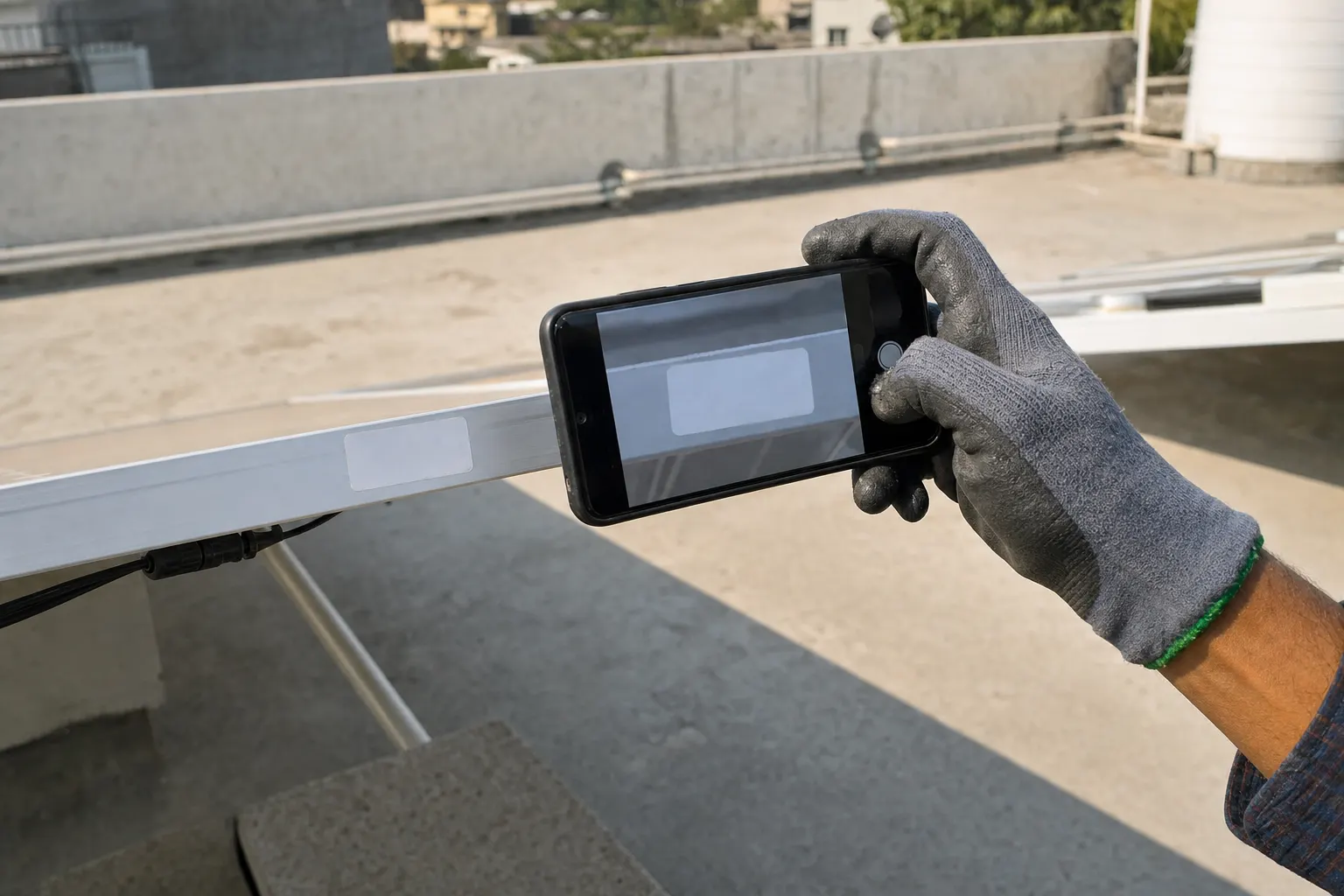 Photograph every module serial label before it goes up. It takes ten minutes and saves a week later.
Document 2: A proper GST invoice, not a quotation or a receipt
A compliant tax invoice carries the installer's GSTIN, your name and the installation address, a clear description of what was supplied, the HSN/SAC code, and the tax shown as a separate line. A quotation will not do. Nor will a payment receipt.
This single page sits underneath more than you expect: warranty claims where the brand asks for proof of purchase date, home insurance that needs an asset value, the resale of your house, and any tax question that comes up years later. Keep the quotation too, since it shows what was promised.
For a single bundled rooftop EPC contract, Circular 177/09/2022-GST of July 2022 treats the supply as a composite supply. In plain terms, one bundled invoice for the whole system is normal, and you should not expect the panels and the labour to be billed as two unrelated sales.
On Input Tax Credit, the split is clean. GST-registered businesses can claim full ITC on a rooftop system, while residential buyers generally cannot, and ITC on inputs tied to exempt residential supply must be reversed under Rule 42. Buying through a firm or an MSME? That invoice is the base document any lender will ask for, and our Gujarat MSME interest subsidy guide walks through the rest of that file.
Now the honest part. Sources disagree on the exact effective GST rate for rooftop solar, and the circular itself dates from 2022, so ask your installer to show you the rate and the notification they are applying rather than trusting a blog figure — including this one.
Document 3: The PPA, but only if you did not pay for the system
A Power Purchase Agreement is what you sign under a RESCO arrangement, where a third-party developer installs, owns and operates the system on your roof and sells you the electricity at a discounted PPA tariff with no upfront capex from you. The PPA then runs for a fixed period, usually 25 years, with the developer carrying the capex and charging a fixed tariff for that duration. The tariff itself is negotiated site by site and varies by state and by load profile, so treat any single quoted rate as an example, not a benchmark.
The agreement has to spell out the tariff and any escalation, the tenure, who maintains and insures the plant, who owns the asset when the term ends, what happens if you sell the house, and how either side can exit. If the clause on house sale is missing, raise it before you sign — the next buyer inherits a contract on their roof, and that becomes your problem at the time of sale.
Here is the point most homeowners miss. PM Surya Ghar central financial assistance applies only to owned installations under the CAPEX model, and RESCO or PPA arrangements where a third party owns the system are excluded from the central subsidy. So if a salesperson offers you a free rooftop system and a government subsidy in the same sentence, stop and ask which of the two you are actually getting. You cannot have both.
Who needs this document? Only PPA and RESCO homeowners. If you paid for your system yourself, skip to the next section.
The caveat: a PPA can still be the right call for a household with no capital to spare and a big daytime load — a home with elderly parents, a borewell pump, or a shop running off the same meter. It is a fair deal on its own terms, as long as nobody promised you a subsidy on top of it.
 One paper set, one scanned copy on a cloud drive. Phones get lost.
Document 4: DCR compliance proof, if you claimed the subsidy
DCR stands for Domestic Content Requirement, and a DCR module is one where both the solar cells and the final module assembly happen in India, verified against MNRE's ALMM List-I and List-II. DCR compliance is mandatory wherever central subsidy applies, including PM Surya Ghar, and only ALMM-listed panels and inverters qualify, installed by an MNRE-empanelled vendor.
Since 1 June 2026 the ALMM List-II mandate reaches the cells themselves, not only the finished modules, for non-exempt projects, with exemptions requested through the dedicated DCR portal. Exemption and verification applications run through the NISE Solar DCR Portal operated by the National Institute of Solar Energy, which is why a genuine paper trail exists behind the modules on your roof. Ask for the module make, model and serial list along with the DCR declaration.
There is a nuance that saves full-price buyers a lot of worry. MNRE has clarified that ALMM List-I and List-II will not apply to behind-the-meter plants set up for captive consumption by private consumers or groups of consumers, excluding government entities and public sector enterprises. A homeowner paying full price with no subsidy is therefore not bound by DCR at all.
Three dates and numbers decide how your file moves: the ALMM List-II cell mandate in force since 1 June 2026, and the official 30-day target from installation to subsidy disbursal against a real-world average of 45 to 90 days depending on your DISCOM's capacity. That spread is a state-level variable, not a national constant.
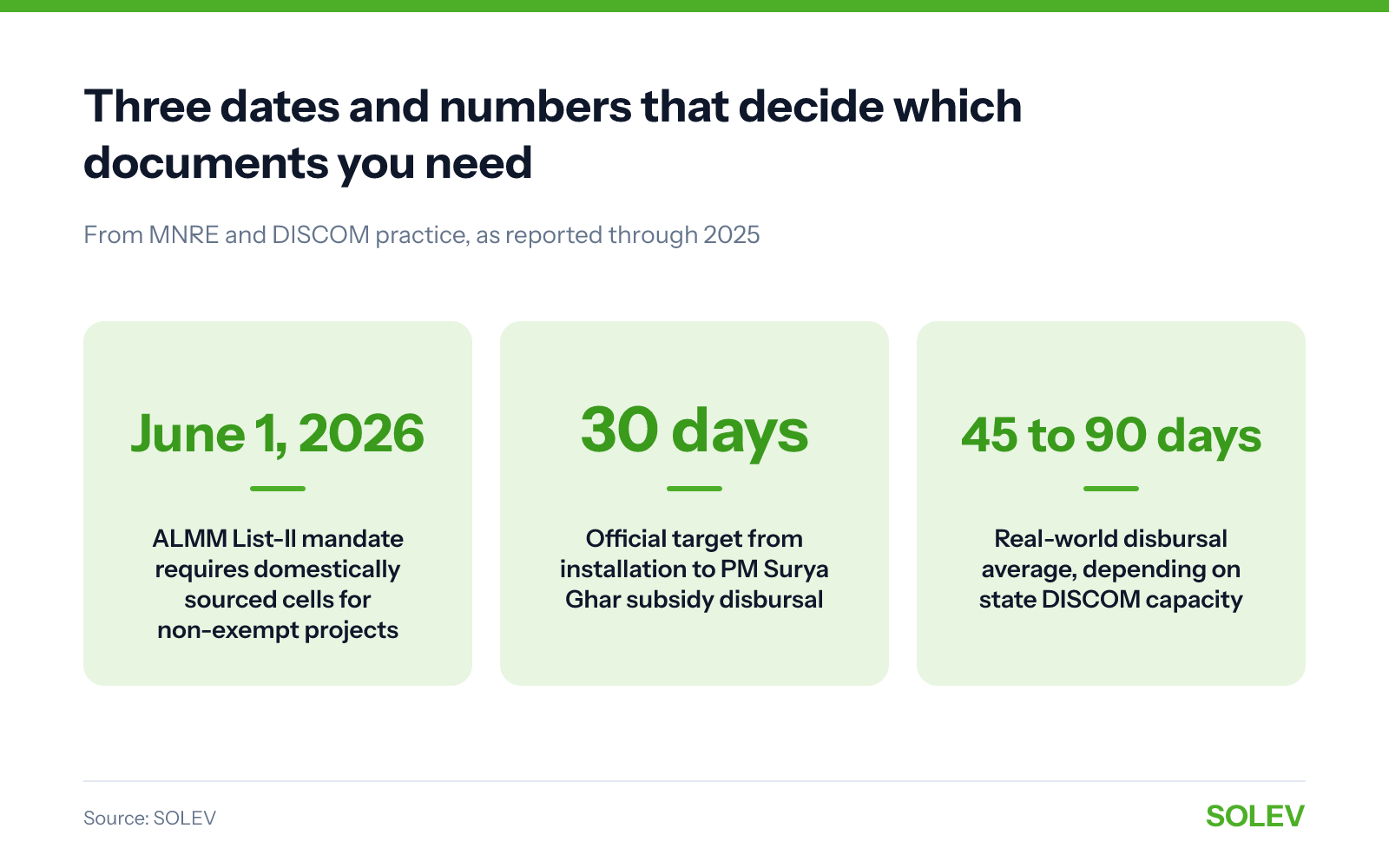 Missing paperwork is a common reason a file sits at the longer end of that range.
Missing documents stretch that wait. In Gujarat we have seen files move faster when the DCR declaration and the DISCOM inspection report were submitted together rather than chased one after the other, and GEDA is the state nodal agency homeowners here deal with alongside the DISCOM. Net-metering forms and inspection formats are not uniform across the country — Torrent Power, PGVCL and DGVCL each run their own process in Gujarat, as do MSEDCL in Maharashtra and BESCOM in Karnataka. If you are still sizing the system that all this paperwork will describe, our guide to calculating the roof space you need is the place to start.
The checklist to save before your installer's team drives away
Tick these five items off before the final payment, not after, because money in hand is your only bargaining power and it stops being that the moment it leaves your account.
- Warranty certificates for the modules, the inverter and balance of system, with serial numbers that match the roof
- GST tax invoice with GSTIN, HSN/SAC and tax shown separately
- PPA copy with tariff, tenure, maintenance, transfer-on-sale and ownership clauses — only if RESCO
- DCR declaration plus ALMM-listed module and inverter details — only if subsidised
- Bonus, and worth insisting on: the single-line diagram, the DISCOM net-meter installation and inspection report, the commissioning report with measured generation in kWh, and your monitoring portal login
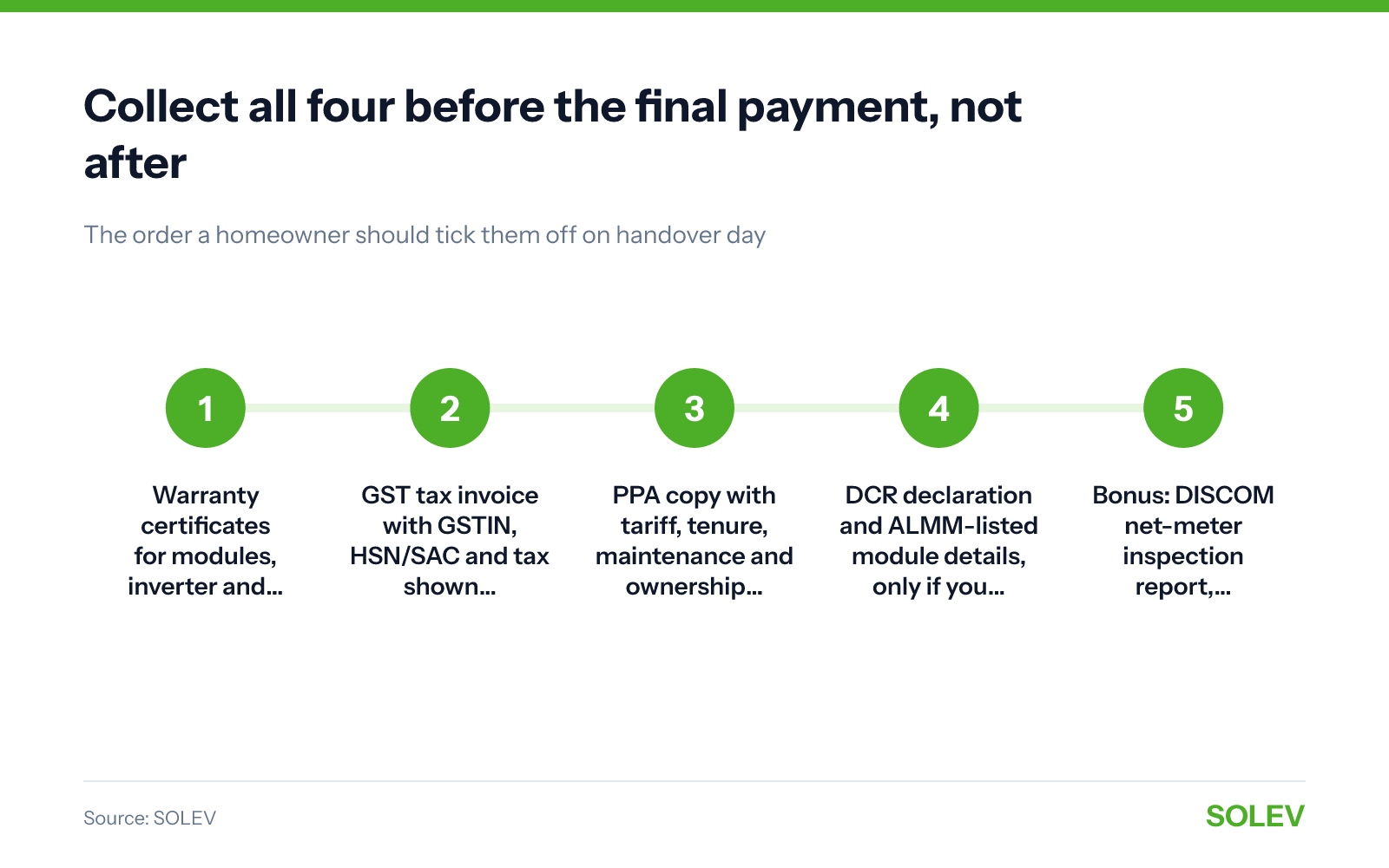 Four documents, two of them conditional. Save this list on your phone before handover day.
On a 6 kW residential rooftop we commissioned in Surat in 2024, the handover folder carried all four documents plus the Torrent Power net-meter report. The homeowner keeps the paper set in a drawer and a scanned copy on a cloud drive.
Do that second part. Phones get lost, drawers get cleared out during a repaint, and a scan takes four minutes.
Send this to the next person you know who is about to install, because most people learn the list only after they need it. Still deciding whether the whole exercise is worth it? Read why we think solar is the right call for most Indian homes.
Frequently asked questions
Am I eligible for the PM Surya Ghar subsidy if I am on a PPA or RESCO deal?
No. PM Surya Ghar central financial assistance applies only to owned installations under the CAPEX model, and RESCO or PPA arrangements where a third party owns the system are excluded. If someone offers a free system and a subsidy together, ask them to put it in writing.
What happens to my solar PPA if I sell my house?
The PPA runs with the installation, not with you, so the agreement must say how it transfers to the buyer. A conventional RESCO PPA is signed for a fixed period, usually 25 years, which means a sale in year six leaves most of the term outstanding. Look for a transfer or assignment clause, a buy-out price and an exit penalty before you sign; if those three are missing, ask for them in writing.
Does DCR apply to me if I am not taking any subsidy?
No. MNRE has clarified that ALMM List-I and List-II do not apply to behind-the-meter plants set up for captive consumption by private consumers, excluding government entities and public sector enterprises. DCR is mandatory wherever central subsidy applies, including PM Surya Ghar.
What should a compliant GST invoice for rooftop solar contain?
The installer's GSTIN, your name and the installation address, a clear description of the supply, the HSN/SAC code and the tax shown as a separate line. For a bundled rooftop EPC contract, Circular 177/09/2022-GST of July 2022 treats it as a composite supply, so one invoice for the whole system is normal. GST-registered businesses can claim full Input Tax Credit; residential buyers generally cannot, and the EPC must reverse ITC under Rule 42.
My inverter fails in year five. What do I actually need to claim warranty?
The warranty certificate, the inverter serial number and the GST invoice. That is how the Rajkot claim on a 5 kW system moved in two days in 2024. MNRE has also directed inverter makers to cover data loggers under the inverter warranty, so check whether your monitoring hardware is included.
How long does PM Surya Ghar subsidy money take to arrive?
The official target is 30 days from installation to disbursal, while the real-world average runs 45 to 90 days depending on state DISCOM capacity. The gap is state-specific: a file with Torrent Power in Gujarat, MSEDCL in Maharashtra or BESCOM in Karnataka will not move at the same pace, and completeness of your document set is the one variable you control.
Does my installer have to be MNRE-empanelled?
For a subsidised installation, yes. Only MNRE-empanelled vendors can execute a subsidised job, and only ALMM-listed panels and inverters qualify. Check the empanelment before you sign, not after.
Sources
- RESCO Model: i.
- 1 MANIREDA’s GUIDELINEs FOR GRID CONNECTED ROOFTOP SOLAR POWER PLANT · 3077 days ago
- Draft Guidelines for implementation of PM-Surya Ghar · 1002 days ago
- PM Surya Ghar Muft Bijli Yojana Apply · 134 days ago
- PM Surya Ghar Muft Bijli Yojana 2026 · 37 days ago
- PM Surya Ghar Muft Bijli Yojana- Online Apply, Eligibility, Documents pmsuryaghar.gov.in 2025| पीएम सूर्यघर योजना| · 569 days ago
- PM Surya Ghar 2026 — Free Electricity, ₹78K Subsidy
- PM Surya Ghar Muft Bijli Yojana Govt. Subsidy on Solar Panel · 394 days ago
- PM Surya Ghar Muft Bijli Yojana 2026: complete subsidy guide for rooftop solar — Earth Energy Log · 106 days ago
- PM Surya Ghar Muft Bijli Yojana