
Neither technology wins outright. For a Surat homeowner with a 350 sq ft terrace, TOPCon earns its premium if it lets 3 kW fit where Mono PERC would have run out of roof. For a wide, unshaded terrace on a tight budget, Mono PERC is still a sound buy. Both qualify for the same subsidy.
Figures as of October 2026.
Both panel types sell every day in Ahmedabad, Rajkot and Surat, and both will make power for decades. What separates them is how much power, in what conditions, and for how long. Panel economics also vary by state through tariffs, net-metering rules and DISCOM processes, so treat any single state's numbers as an example, not a national figure.
Why price per watt alone will mislead you
Price per watt alone cannot tell you which panel is right because it ignores roof area, budget and your actual consumption pattern. It is a useful tiebreaker and a terrible starting point.
Every panel legally allowed on a subsidised rooftop in India already clears a quality floor. It must sit on ALMM List-I, and meet BIS IS 14286, India's adoption of IEC 61215 with changes for our conditions. That is a floor, not a guarantee. Passing those tests says a module is safe and properly built; it says nothing about whether two modules generate the same units over 25 years, because IS 14286 does not test long-term UV degradation, humidity-freeze cycling or thermal stress across decades.
Subsidy flattens the picture further. Under PM Surya Ghar, central financial assistance (CFA) is fixed by system size: Rs 30,000 for 1 kW, Rs 60,000 for 2 kW and Rs 78,000 for 3 kW or above. Same rupee amount, any ALMM-listed panel. This CFA structure and the loan figures below are current as of September 2025 per the source and should be rechecked periodically since scheme numbers can move.
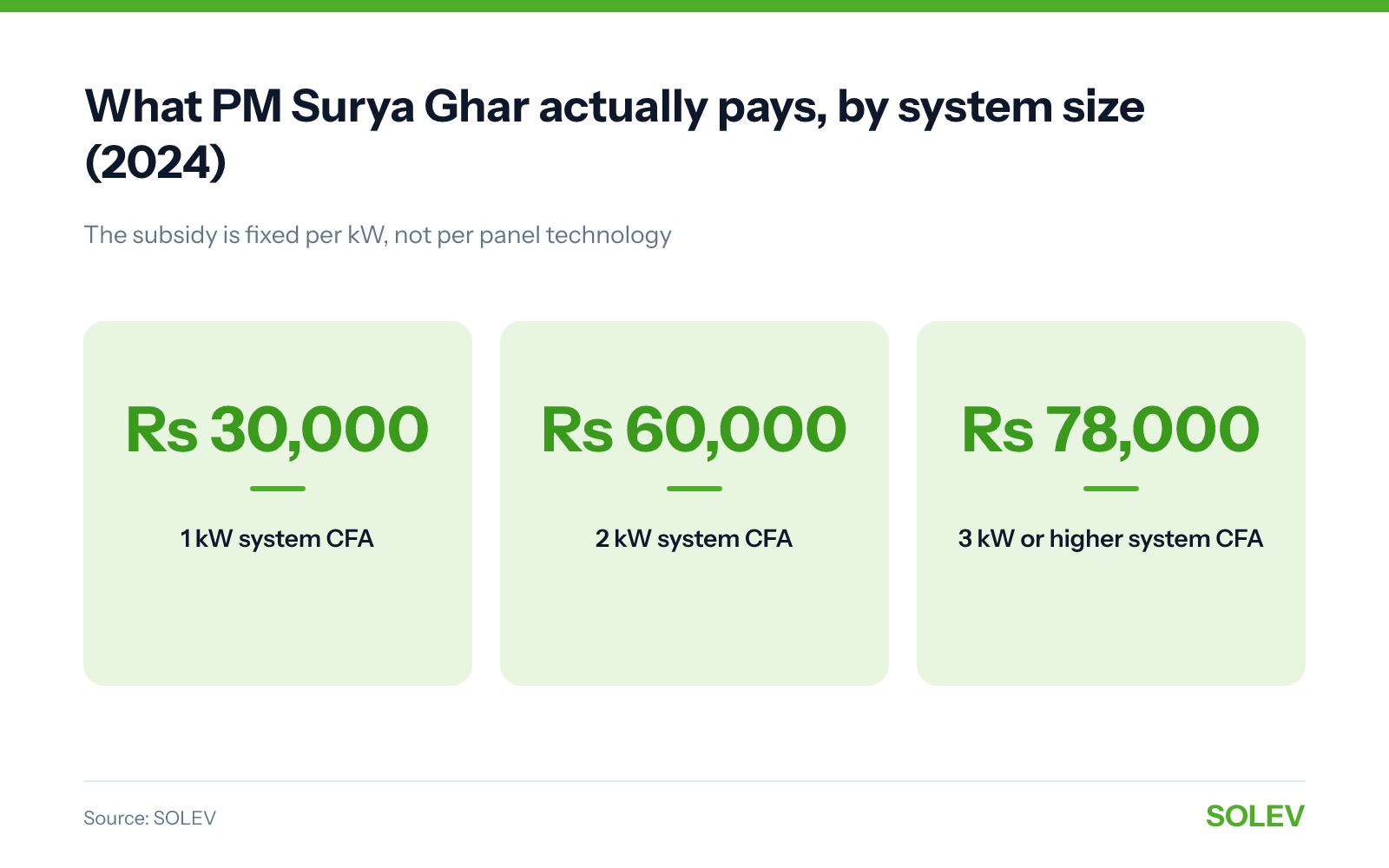 Central financial assistance under PM Surya Ghar scales with capacity, not panel brand or technology.
That fixed CFA takes the sting out of the sticker price, which is good. The side effect: buyers argue over the last few rupees per watt and ignore the thing that decides returns in year twelve. Still deciding whether to install at all? Start with why solar energy is the future and come back here.
What makes a TOPCon panel worth considering
TOPCon is worth considering because it packs more output per square metre, degrades more slowly, and holds efficiency better in heat and low light than Mono PERC. TOPCon stands for Tunnel Oxide Passivated Contact, a newer cell design built on n-type silicon.
By 2026 it has become the dominant mass-production module type globally, with Mono PERC sliding into the budget and legacy slot. Four things make it interesting for an Indian rooftop. Module efficiency is higher, so a given capacity occupies less area. Low-light performance is better, which matters through a Gujarat monsoon and in the first and last hours of the day: n-type TOPCon panels tend to show lower degradation and hold relative efficiency better than standard Mono PERC at low irradiance of roughly 200 to 400 W/m\u00b2. Add those up and you get more energy over the life of the plant.
Heat is the enemy. A rooftop in Ahmedabad or Rajkot in May runs far hotter than any datasheet's lab conditions, and every panel loses output as it heats up. TOPCon's temperature coefficient is less negative than PERC's, so it sheds comparatively less output as the module heats, though this is a directional claim from industry commentary rather than a single cited test figure. On a Gujarat or Rajasthan roof, that shows up in the afternoon generation curve every summer; in other states the gap will track local temperature patterns rather than this exact number.
Now the honest part. The premium over Mono PERC is moderate, not huge, and it is justified by expected long-term generation, not guaranteed by it. If your roof is large, unshaded and your consumption is modest, you may never recover that premium in a way you can feel on a bill.
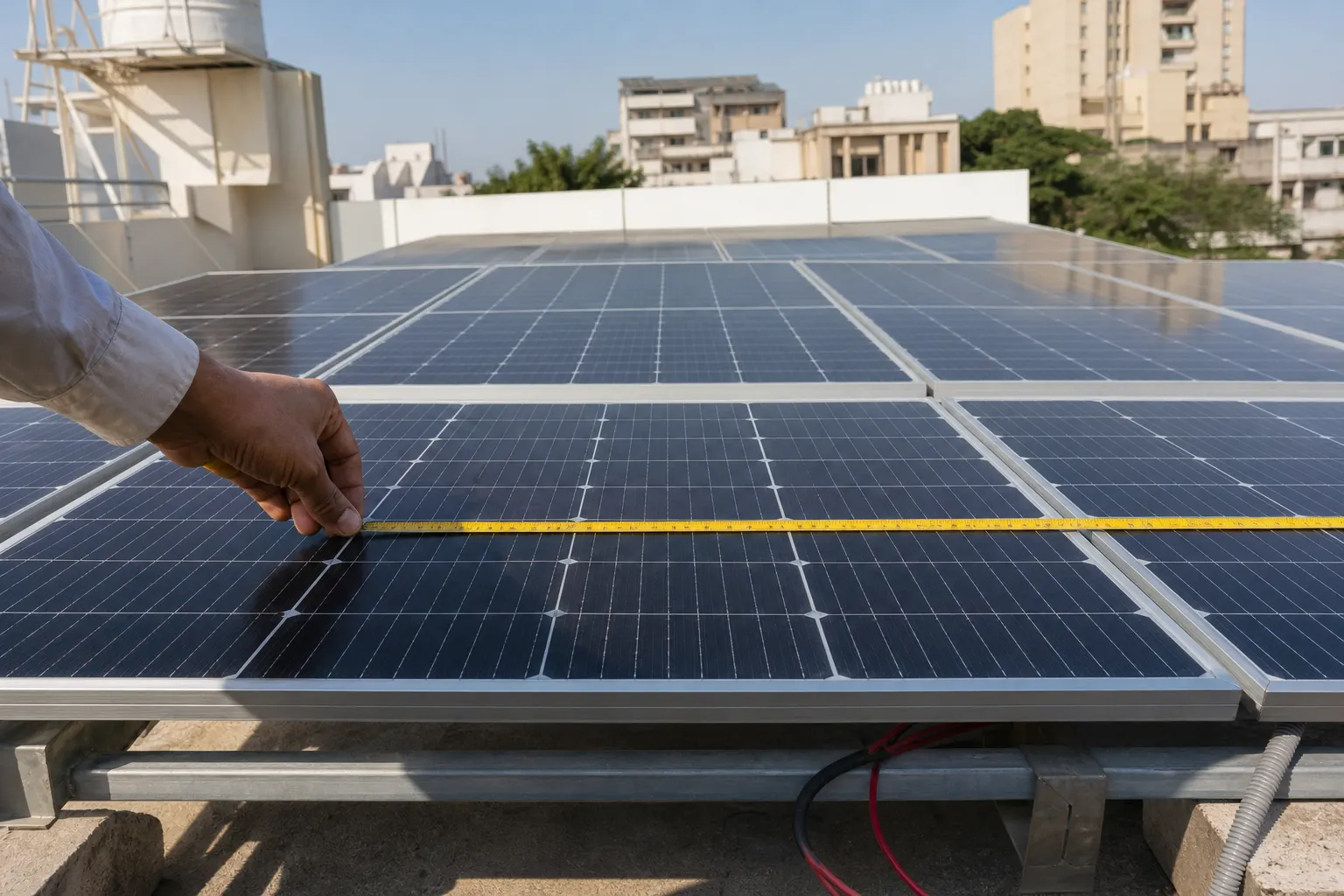 On tighter roofs like this 350 sq ft Surat terrace, higher-efficiency panels mean more capacity fits the same space.
What makes a Mono PERC panel still a sound choice
Mono PERC remains a sound choice because it costs less, is widely stocked, and performs perfectly well on an unshaded, budget-constrained roof. PERC means Passivated Emitter and Rear Contact, starting with p-type silicon and a dielectric passivation layer at the back of the cell.
It went mainstream around 2018, so there are now seven-plus years of field behaviour behind it on Indian rooftops. Proven is worth something. Mono PERC is cost-effective, widely stocked, and performs perfectly well on standard residential and commercial plants. For a bungalow in Rajkot with a large flat terrace and no water tank casting a shadow, a PERC layout will often deliver the capacity you wanted at a lower total project cost, and the PM Surya Ghar CFA stays identical either way.
Choose PERC when budget is the binding constraint, roof area is not, and your consumption lines up with midday sun rather than every extra unit scraped out of a cloudy morning. We explain how the rest of the project cost stacks up in our note on solar panel cost for homes in India, because modules are only one line in the quotation.
The caveat is real. If your roof has frequent shading from a parapet, a neighbouring building or a mobile tower, or if you plan to never look at the system again for 25 years, PERC's higher degradation and weaker low-light behaviour will cost you quietly. You will not notice it in year one. You will notice it when a ten-year-old array sits next to your neighbour's newer one.
How your roof, budget and consumption change the answer
Space decides more than price, because a higher-efficiency module produces the same kW from fewer square metres. On a compact terrace TOPCon can be the difference between fitting 3 kW and settling for 2 kW. That gap also costs Rs 18,000 of subsidy, since PM Surya Ghar pays Rs 60,000 at 2 kW and Rs 78,000 at 3 kW. Work out your own constraint first using our guide to calculating required roof space for solar panels.
On budget, the structure of the scheme matters. The CFA is fixed per kW, so technology choice changes only the portion you fund yourself, never the subsidy. Collateral-free loans at around 7% are available through the JanSamarth route for residential systems up to 3 kW. Over 5.79 lakh such loans worth Rs 10,907 crore had been sanctioned as of September 2025 \u2014 that is the latest national figure available and is worth rechecking if you read this much later, since loan uptake moves quickly.
Consumption decides the rest. A factory office in Surat running compressors and air conditioning from 10 am to 6 pm consumes exactly when roof temperatures peak, so a better temperature coefficient turns into self-consumed units rather than exported ones. A home that runs mostly in the evening exports more and leans on net-metering credit, where the marginal summer gain matters less. This is why commercial rooftops often justify TOPCon more easily than homes do.
One of our installations makes the space point concretely. A homeowner in Surat with a 350 sq ft usable terrace, minus a water tank and a stair head, wanted the full 3 kW to claim the Rs 78,000 CFA. A standard Mono PERC layout needed more area than the terrace had. We laid out the system with a higher-efficiency panel instead, and the 3 kW fit.
Net-metering is a separate conversation from panels, and it varies by state. In Gujarat the process runs through GUVNL and your local DISCOM, and sanctioned load, meter type and export settlement rules differ by circle; other states route this through their own DISCOMs with different timelines. Confirm your own DISCOM's rules before you finalise capacity.
The 7-factor checklist to compare before you buy
Compare panels on efficiency, degradation rate, warranty, brand, temperature coefficient, price per watt and expected generation \u2014 in that order, not price first. The module must carry BIS IS 14286, meet IEC 61215, and appear on ALMM List-I, currently at Revision 51 dated 16 September 2026 and running to 328 pages. Without List-I registration, there is no PM Surya Ghar subsidy and usually no DISCOM interconnection.
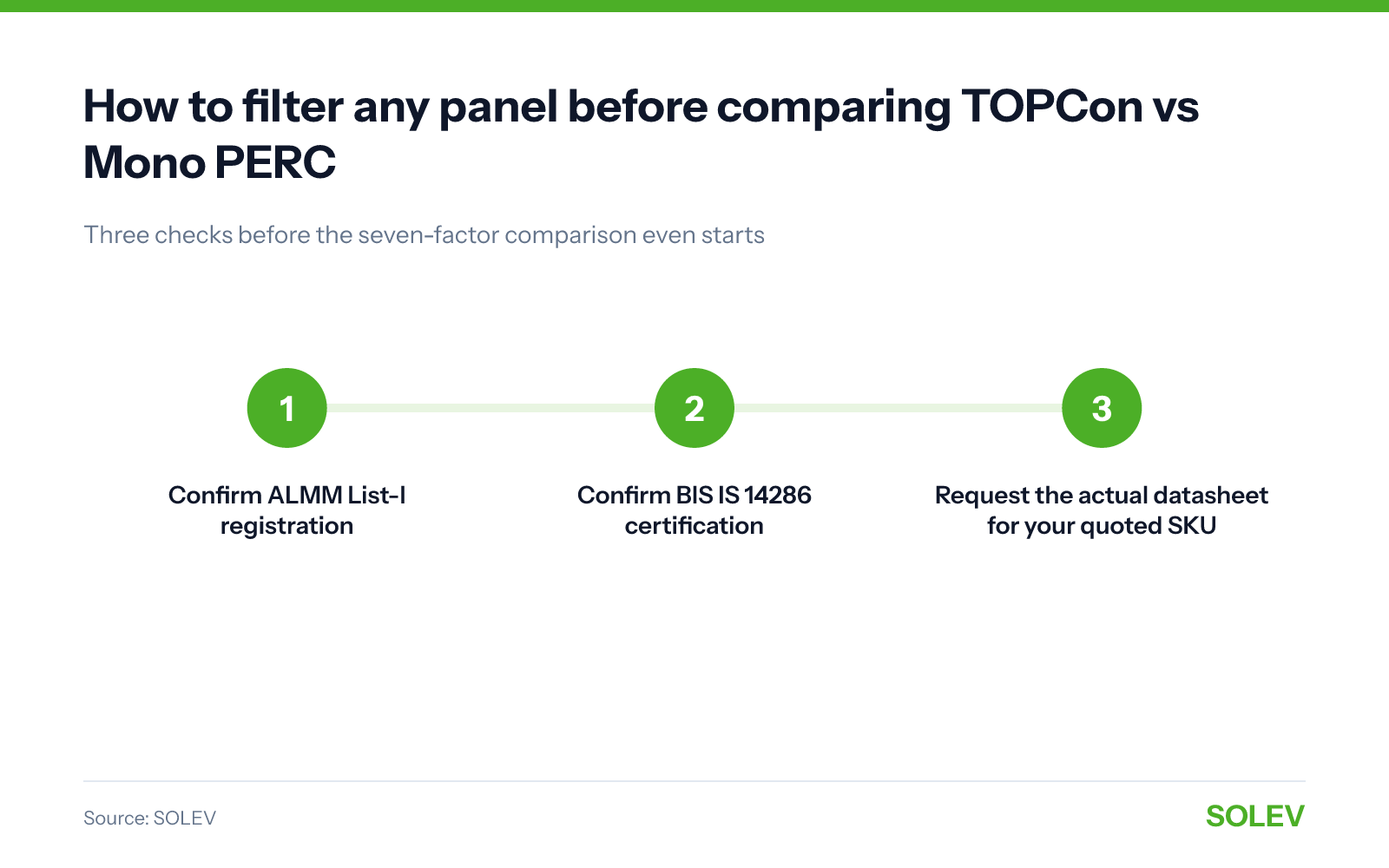 These three checks come before efficiency, price or warranty comparisons matter.
Once a panel clears that, compare these seven things across the exact models you have been quoted:
- Efficiency \u2014 watts per square metre. Decides whether your target capacity fits your roof.
- Degradation rate \u2014 first-year loss and annual loss after that. It compounds, which is why it decides year-fifteen output more than anything else on the sheet.
- Warranty \u2014 read both the product warranty and the separate performance warranty, and check who honours them in India.
- Brand \u2014 a warranty is only as good as the company behind it. Names on ALMM List-I include Waaree, Adani Solar, Tata Power Solar, Vikram Solar and Premier Energies.
- Temperature coefficient \u2014 output lost per degree of heating. On an Ahmedabad roof in May, this is not theoretical.
- Price per watt \u2014 compare it last, against the six factors above.
- Expected generation \u2014 units per kW per year for your location and tilt. This is the figure your payback is actually built on.
Ask for the datasheet. Not a brochure, not a WhatsApp forward \u2014 the manufacturer PDF for the specific SKU in your quotation, for both the TOPCon and the Mono PERC option. Generic online comparisons describe an average panel nobody is installing on your roof.
Curious what comes after both of these? Our comparison of perovskite vs silicon solar panels covers the technology still in the lab and early pilots.
Save this checklist before you choose your panels
There is no universal winner here, only a better fit for one specific roof, one budget and one consumption pattern. TOPCon buys efficiency, heat tolerance and a slower decline. Mono PERC buys a lower project cost on a technology proving itself on Indian rooftops since 2018.
Chasing the lowest price per watt without checking the other six factors is how buyers end up disappointed in year eight rather than year one. By then the installer's number has changed, and the panel is on your roof for another seventeen years.
Keep the seven factors somewhere you can pull up in front of a salesperson. Then get a free solar quotation that prices both a TOPCon and a Mono PERC layout for your actual roof dimensions, so you compare two real options instead of two internet averages.
Frequently asked questions
Is TOPCon always better than Mono PERC for rooftop solar?
No. TOPCon has higher efficiency, better low-light output and lower degradation, but the premium only pays back if your roof is tight, hot, partly shaded, or your consumption is heavily daytime. On a large unshaded terrace with a limited budget, Mono PERC remains a sensible choice.
Does PM Surya Ghar subsidy change based on panel technology?
No. The CFA is fixed by system size \u2014 Rs 30,000 for 1 kW, Rs 60,000 for 2 kW and Rs 78,000 for 3 kW and above \u2014 regardless of whether the module is TOPCon or Mono PERC. The panel must be on ALMM List-I to qualify at all.
Do I need ALMM and BIS certification regardless of panel type?
Yes. BIS IS 14286 for quality, IEC 61215 for performance and durability, and ALMM List-I registration for subsidy and most DISCOM interconnections apply to every technology. Check this before comparing anything else.
Will TOPCon panels need less roof space than Mono PERC for the same capacity?
Generally yes, because higher module efficiency means more watts per square metre. On our Surat installation, a 350 sq ft terrace took the full 3 kW with a higher-efficiency layout where a standard Mono PERC layout would have needed more area.
Can I mix TOPCon and Mono PERC panels on the same rooftop system?
Not within the same string. Modules of different electrical characteristics on one string drag each other down, and it complicates warranty claims. Separate strings with matched modules on compatible inverter inputs are the cleaner approach \u2014 ask your installer to show the string design before you agree.
Sources
- PM Surya Ghar Muft Bijli Yojana
- Solar Panel Efficiency: What It Means (2026) · 208 days ago
- APPROVED LIST OF MODELS AND MANUFACTURERS (ALMM) | MINISTRY OF NEW AND RENEWABLE ENERGY | India · 8 days ago
- Cabinet approves PM-Surya Ghar: Muft Bijli Yojana for installing rooftop solar in One Crore households
- ALMM List 2026 · 136 days ago
- ALMM list 2026: approved panels for PM Surya Ghar - r-solar · 10 days ago
- 2026 ALMM Guide: Approved Solar Module Manufacturers List · 56 days ago
- ALMM List-II for Solar Cells: What Changes from June 1, 2026 · 140 days ago
- MNRE Adds 10,494 MW to ALMM List-I in July 2026 Update · 91 days ago
- Latest MNRE List: Approved Solar Module Manufacturers · 226 days ago